
11.5. 2026 Katri Valkokari
Many ecosystems describe themselves as “open”, but a closer look often tells a different story. Membership criteria are often implicit, participation is uneven, and access to information or decision-making tends to concentrate in a small inner circle. That does not make an ecosystem “bad”; it makes it human.
The leadership challenge is not to deny this reality, but to be intentional about it: what is open, what is not, and how actors can move between those spaces over time.
Openness is a principle, not a participation model
In every collaboration, you will see different levels of activity. Social media makes this visible – some post daily, others only read or like – but the same pattern appears in innovation ecosystems, clusters, and communities of practice.
When these participation layers are ignored, leadership tends to fail in predictable ways. Some ecosystems over-manage, trying to push everyone to be equally active. Others underlead, assuming the ecosystem will somehow self-organise. Recognising participation layers enables deliberate orchestration of interaction and keeps ideas flowing without enforcing uniform engagement.
The unspoken layers inside “open” ecosystems
Most ecosystems, whether they admit it or not, operate through a layered structure.
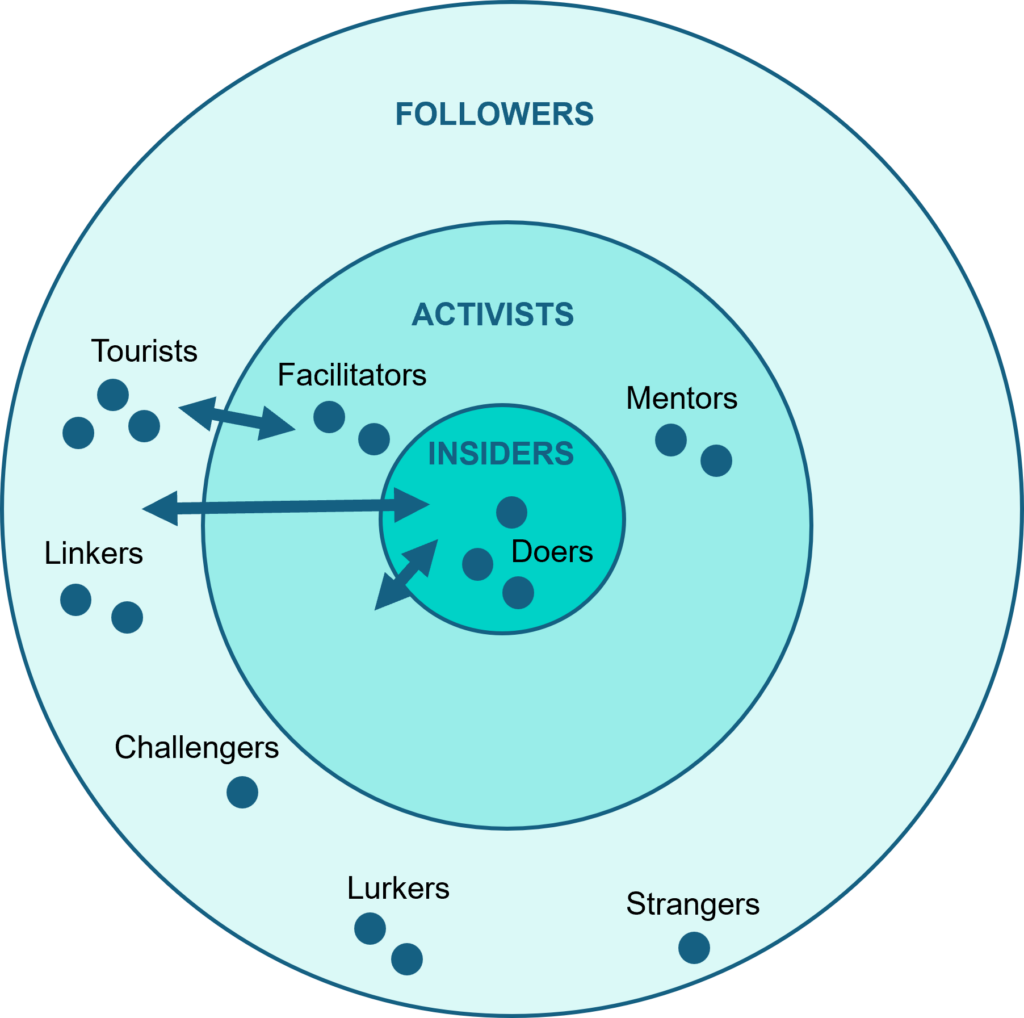
At the core is a small group of insiders. They carry responsibility for agenda-setting, prioritisation, and keeping the ecosystem focused on its shared value proposition. Around them are the activists: the actors who turn ideas into tangible outcomes – pilots, prototypes, proposals – as well as facilitators who mobilise others and mentors who help newcomers find their way in.
Beyond this sits the widest circle: followers. This group is often misunderstood as passive, even though it includes linkers who connect people and topics across boundaries, challengers who question assumptions and sharpen ideas, lurkers who quietly learn and apply insights elsewhere, and occasional participants who appear only sporadically, for example, at annual events.
This structure is not a design flaw. It is the normal social architecture of collaboration – and something that needs to be led, not flattened.
Movement between layers is how ecosystems renew themselves
One key renewal mechanism is enabling movement between layers, particularly from follower to activist. This rarely happens through exhortation or pressure. It happens when entry points are visible, the cost of contribution is low, and small acts of participation are recognised rather than dismissed.
The trap is insisting that everyone should operate at the activist level. Many participants will never fully align with the ecosystem’s goals, and that is acceptable – as long as expectations are explicit. Trying to extract equal effort from everyone often leads to disengagement rather than commitment.
The quieter risk: efficiency without innovation
There is, however, another risk that is easier to overlook. When communication and decision-making remain concentrated within the insider and activist layers, ecosystems can become efficient but gradually less innovative.
Those outside the core often carry different contexts, weak signals, and ideas that sit close to what is realistically possible next. Orchestration is not about opening everything to everyone. It is about creating pathways for these insights to surface without overwhelming those who do most of the delivery work.
Participation inequality creates friction – unless it is acknowledged
Even when partners are “equal” in principle, uneven participation creates emotional and practical friction. Highly active contributors may feel they are carrying others – and may start withholding knowledge if they believe others are only taking, not giving.
A pragmatic response is to design different arenas with different expectations: open spaces for learning and visibility, working groups for delivery, and more closed settings for sensitive or strategic discussion. When the purpose of each space is explicit, people can participate without constantly navigating unspoken rules.
Orchestration is the leadership of interaction
So, what is ecosystem orchestration in managerial terms? It is leadership of interaction: shaping how actors meet, decide, share, and build – and continuously tuning those practices as the ecosystem evolves.
Crucially, orchestration is not something you do to an ecosystem. It is something you form with it. You may not involve a hundred members in every decision, but you can make principles transparent and create structured ways for input. This is how openness and a clear inner circle can coexist without undermining trust or innovation.