
26.10.2026 Katri Valkokari
Ecosystem partners rarely work to the same clock. Leaders must balance near-term business opportunities, medium-term renewal, and long-term system change while involving the right actors at each stage. This post introduces three complementary approaches – business adjusting, change triggering, and future shaping – and shows how managers can align their timing, participation, and collaboration boundaries.
Why should we collaborate on strategic foresight?
Managerial purpose for ecosystem foresight distinguishes the three complementary approaches to ecosystem foresight presented in Figure 1, each of which generally operates on a different time horizon. Business adjusting identifies near-term opportunities and develops offerings with known partners. It typically takes place bilaterally between companies and their customers or suppliers and focuses on the incremental development of existing offerings. Change triggering brings in new partners, builds knowledge, and helps organizations break existing path dependencies. Future shaping enables ecosystem actors to anticipate and influence developments across industry boundaries.
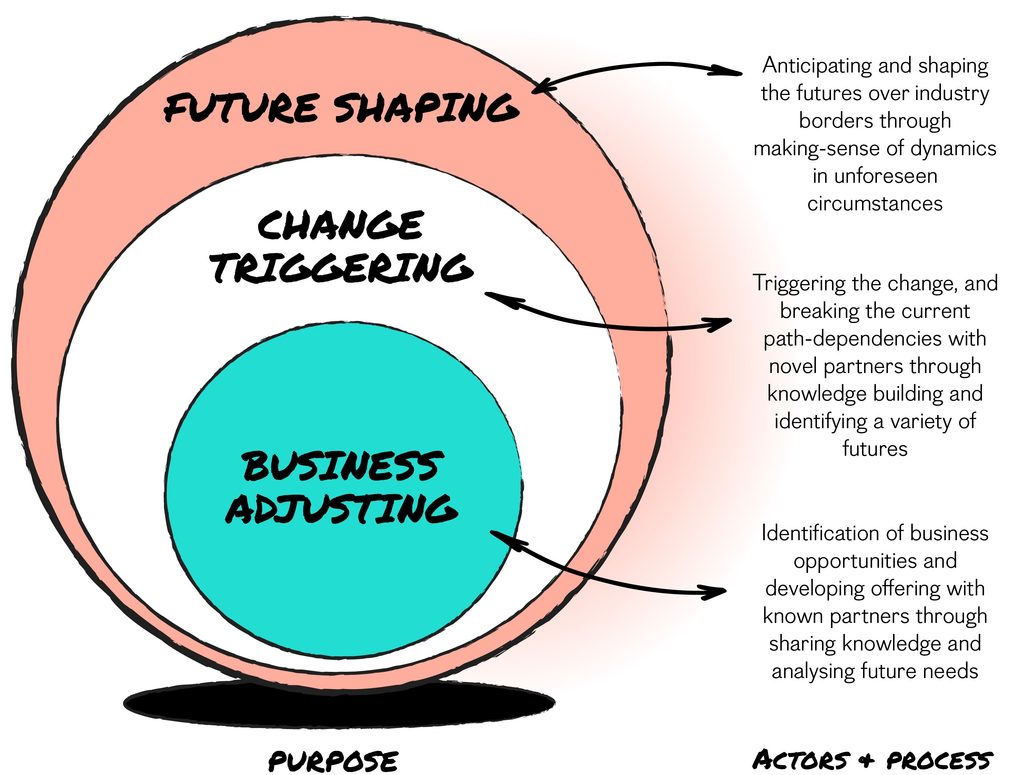
Business adjusting focuses on the short term, change triggering on the medium term, and future shaping on the long term. For leaders, the key implication is that each horizon requires different expectations, resources, and governance. The purpose of the foresight activity should determine which experts and ecosystem actors are invited to contribute. The participants – and their willingness to share insights – shape which futures the ecosystem can imagine.
Near-term adjusting can be managed through focused activities and bilateral customer or supplier relationships. In the business adjusting, company-specific commercial negotiations need to be done bilaterally, whereas broader ecosystem explores shared future needs, trends, ecosystem structures, and possible forms of collaboration.
Medium-term change triggering requires room for experimentation, new partners, and learning before concrete development paths can be identified. Within the process NGOs, activists, and other parties whose views may conflict with the ecosystem’s vision can help expose blind spots and assess whether the shared vision is robust.
Long-term future shaping calls for constant commitment, broader coalitions, and progress measures that capture capability building, regulatory change, and ecosystem alignment rather than immediate returns. Managers need to broaden the conversation beyond established assumptions by intentionally including perspectives from different ecosystem layers, generations, external challengers, and interest groups. Then, carefully chosen topics and presenters can move the ecosystem’s thinking about future forward.
What should we understand about timeframes?
The time horizons also depend on perspective: five years may be long term for an individual company, while an ecosystem may need to look several decades ahead. Progress can therefore be slowed by technological feasibility, incumbent business models, or regulation. Timeframes also vary by industry, and in cross-sectoral collaboration actors have different expectations about speed, readiness, as well as focus. Leaders should make these assumptions visible early and agree on horizon-specific milestones, decision points, and indicators of progress.
However, time horizons are only one part of the foresight process. Before starting joint work, ecosystem actors should explore and align: How do participants interpret the relationship between the past, present, and future? and To what extent can activities be synchronized across ecosystem organizations? What decisions can be made now, and which outcomes require patience? Making these temporal choices explicit helps partners determine whether, when, and how quickly the ecosystem can act toward shared futures.
- Valkokari, K., Paasi, J., Nuutinen, M., Apilo, T., & Huuhanmäki, J. (2024). Building futures by networked foresight. In A.-J. Tahvanainen, & T. Apilo (Eds.), Guidebook for organising corporate foresight (pp. 72-84). VTT Technical Research Centre of Finland. https://doi.org/10.32040/2024.978-951-38-8838-1